Showing posts with label beginners. Show all posts

Thursday, 21 April 2011

Swimming Styles

Let's now turn our topic from gym to swimming.

Swimming, either casual or competitive, is a fun cardiovascular exercise. It mainly requires you to be "moving forward (or backwards)" in water. Compared to other sports, this doesn't make you sweat!

There are four major swimming styles:

  1. Freestyle

    • Arms: Palms should be cupped, with fingers sticking to each other. Arms move in an "alternating windmill motion", i.e. alternatingly, each palm pushes the water downwards, then moves in a "circular" motion, comes out of water, then "dives" back into the water (do not hit your entire palm onto the water).
    • Legs: Legs should be straightened and alternatingly kick each leg above and below of the water surface.
    • Breath: When moving one arm in the windmill motion, tilt your head towards the direction of that arm, then breathe in. When your arm comes back into the water, tilt your head back into the water and either breathe out slowly or hold your breath.

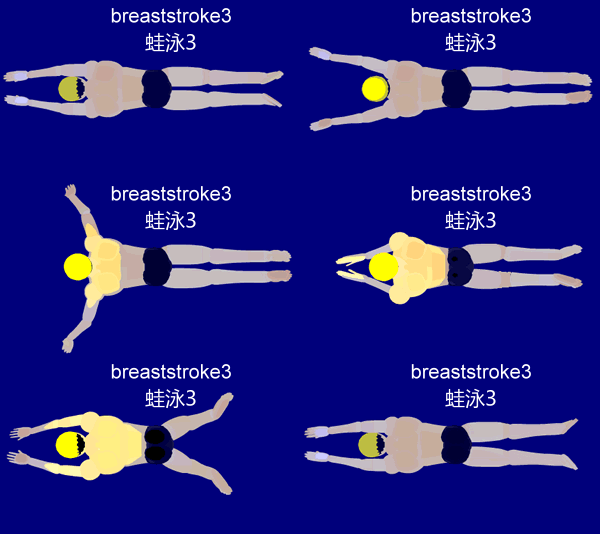
  2. Breaststroke

    • Arms: Arms are straight and in front of the head initially. Push your hands outwards, then come towards the chest and finally straighten.
    • Legs: Resembles the movement of the frog's hind legs. Each time your arms are going back to the original straightened position, bring your knees towards your chest, then thrust both legs backwards together.
    • Breath:  During each arm stroke, bring your head out of the water surface, breathe in, then back into the water and either breathe out slowly or hold your breath.

  3. Backstroke


    This is the similar to freestyle, the difference being the swimmer is facing the ceiling, with head out of the water surface.
    • Arms: Same as freestyle - move arms in an "alternating windmill motion".
    • Legs: Same as freestyle - alternatingly kick your straightened legs above and below the water surface.
    • Breath: Different from freestyle - since head is always out of the water surface, breathe when needed.

  4. Butterfly Stroke


    • Arms: Hands are initially in front of the head. With hands cupped, push your palms outwards, pressing downwards and outwards. Then swing your arm in a "sweeping motion" above the water to return to original position.
    • Legs: Initially bend your knees slightly and keep them next to each other. Then straighten and thrust your legs downwards. Return to original position. For every arm stroke, there must be two kicks!
    • Breath: Bring head out of water during an arm stroke to breathe in, then bring it back into the water to either breathe out slowly or hold your breath.
Before trying the above swimming styles, remember to learn the kicking and breathing basics, probably with a float and/or flippers. Also, always warm up before swimming!
Enjoy!

TeamNotSoCool
Sinn-Shun

Wednesday, 13 April 2011

Treadmill for Beginners

Beginners to the gym,
looking for which exercise to start with amongst the various types of machines you see in the gym?
Do not worry! You could always start off with light exercises - on the treadmill!

Treadmill

There are a few possible reasons you would want to use a treadmill:
  1. To keep fit or lose weight- treadmill exercises (walking, jogging or running) are a type of cardiovascular exercise which helps to increase metabolism and hence burn calories
  2. To stay healthy - you might not like strenous exercises and prefer light exercises, then the treadmill would suit you
  3. Just to look cool or just to boast that you went to the gym to your female/male friends

So how do you start off with the treadmill?

An example of the screen of a treadmill
  1. After stepping on to the treadmill, look at the screen on the treadmill (it should be quite similar in terms of basic functionality to the above picture). Hit start to begin.
  2. Firstly, warm-up with the initial speed the treadmill sets for you (probably around 2kmph). It's our normal walking speed.
  3. Then, gradually increase the speed as desired. This differs from people to people, so decide on this yourself by trying out each range of speed. Remember, if you have not been exercising for very long, please do not expect yourself to be able to run at a high speed (e.g. 20kmph for 30minutes) when you first begin. (My suggestions: 4-5kmph would be a slightly faster walking speed, 6-7kmph for brisk-walking, 7-10kmph for jogging, 10kmph and above for running.)
  4. Once you start to feel unusually tired or that your legs are slightly painful/sore, be aware that you should be stopping sometime soon. If you feel uncomfortable (e.g. dizzy, nauseous, or leg cram), please stop immediately. If you were jogging/running, please gradually slow down the speed before you hit the Stop button. This action of cooling down is important (as described by the previous post).
Important things to note:
  • Keeping a good posture helps. A good posture is by pumping your arms as you walk/jog/run, while keeping your head up and looking forward
  • STOP IMMEDIATELY if you feel uncomfortable (e.g. dizzy, nauseous, or leg cram). Do not outstretch yourself especially if you haven't been working out for a long time.
I hope these advices would be good for you beginners! Once you're good with the treadmill, try taking new self-challenges by increasing the speed or increasing the slope. Or you might want to venture on to abs blasting exercises/machines to look even cooler!

Have fun!

TeamNotSoCool
Sinn-Shun